Friday, 9 October 2020

The Great War Group

The Great War Group: a vibrant new community, bringing you education, research and commemoration of the First World War

The Great War Group was founded in 2020 as a non-profit, Foundation CIO to promote education on, and commemoration of the First World War. Their approach is wide-ranging, considering all fronts, and all nations involved in the conflict.

For a good introductory note on the aspirations and plans of the Group see the following news item on the their web site: A New Group For Everyone To Enjoy

At the Great War Group they are committed to providing a quarterly magazine with diverse and engaging content that explores all facets of the conflict. The first of these is devoted to remembrance and will be over 100 pages long. See: Salient Points for plans for the coming year, and Remembrance for information on the November 2020 edition of Salient Points.

For full information and membership details see The Great War Group website.

Tuesday, 4 December 2018

Alfred Redfern Adams

photo courtesy Mike McQuaid
Alfred Redfern Adams was born in 1898, the son of Alfred and Eleanor (nee Ledsham) Adams of Willaston. Educated at Willaston Council School, Alfred enlisted with Cheshire Yeomanry (No. 1297) in October 1914, aged 16.

Through 1914-1916 Cheshire Yeomanry were on home defence duties on the Norfolk and Suffolk Coast. Alfred had two older brothers, Joseph and Frederick, both of whom served with the 1/7th Bn. Cheshire Regiment and were posted overseas in 1915. During leave in November 1915 had Alfred told his father that he did not want to be left in England with his two brothers serving abroad.

On 26 November Alfred returned to his regiment via train from Crewe, bound for Suffolk and his lodging at Lowestoft. He subsequently wrote to his father. On the evening of 4 December, he returned to his lodgings at 7.25pm. About 20 minutes later his landlady, Mrs. Caroline Gardiner, heard a gunshot from Alfred’s room.

Alone in the house at the time, Mrs. Gardiner ran across the road to seek assistance. Trooper William Frederick Scott (No. 1565, Cheshire Yeomanry) entered Alfred’s room and found him lying across his bed with his rifle and bayonet at his side and a wound by his heart.

The Coroner at his inquest in Lowestoft during December returned a verdict of accidental death.

Alfred Redfern Adams was the earliest casualty of Cheshire Yeomanry in the First World War. He is buried at the church of St Mary the Virgin in the village of Wistaston, Cheshire.

Sunday, 11 November 2018

Tournai, November 1918

The city of Tournai in western Belgium was occupied by German forces in August 1914. It remained under German occupation for the rest of the war.

With the British advance in October 1918, the Germans lines had fallen back to Tournai. By mid-October the 15th (Suffolk Yeomanry) Bn. Suffolk Regiment were in the line to the east of Orcq, on the outskirts of Tournai, the village being strongly held by machine guns. The British dug their own line of resistance, and the Battalion spent a few days in the trenches followed by similar period in billets. In the latter part of October these were at Marquain, just 2000 yards from the front line. When billeted the Battalion carried on with a certain amount of training with Lewis guns and in gas drill.

A British soldier
demonstrates a
small box respirator
In the early hours of October 29th about 600 gas and high explosive shells fell in Marquain, and the men were required to wear small box respirators. The chief target had been artillery batteries there. Intermittent gas shelling on the front and support lines continued through the day.

On the evening of October 30th the 15th Suffolks were relieved by the 10th Kings Shropshire Light Infantry, and they moved to billets in Haudion, south west of Marquain. 2nd Lieutenant T.B. Minshall 15th Bn. Suffolk Regiment may have come across some old pals at this time, having served with 10th Bn. KSLI in Egypt and Palestine, prior to his Commission and transfer to the Suffolks in December 1917.

The first few days of November were spent in training and working on the line of resistance – at this time Private Charles Sydney Stevens (No. 51856) 15th (Suffolk Yeomanry) Bn. Suffolk Regiment was killed from artillery fire. The Battalion was also sent to the baths at Baisieux on 3/4 November.

Friday, 5 October 2018

Outpost Encounters

Early in October 1918 the 74th Division took over from the 19th Division a sector of the front line in northern France nearly three miles in length with Neuve Chapelle, in the centre. By then the Germans were in retreat towards Lille, about 15 miles away to the north-east. On the evening of 3 October the 15th (Suffolk Yeomanry) Bn. Suffolk Regiment moved up on to the Aubers Ridge line, as the main line of resistance.

230th Infantry Brigade Order No. 72, dated 2 October 1918, required after arrival on the Aubers Line that patrols should be pushed out. It further required that “Patrol Leaders must show more enterprise. Once the objective is given cumbersome orders only complicate the task and delay operations.”

At 0500 on 4 October the Battalion moved out passing through the positions held by the 10th Buffs and 16th Sussex; two companies were in the front line and two in support, with the 10th Kings Shropshire Light Infantry (KSLI) on their left and Liverpool Scottish the right. The first objective was met by 0915. The advance continued, but was halted at 1030 due to shelling, which wounded six men. The lines were consolidated taking up a defensive position covering the villages of Lattre and Wavrin, with B, C and D Companies in the line and A Company in support. Through the afternoon the Battalion experienced heavy shelling, and patrols sent out encountered enemy machine gun posts about 400 yards ahead. Night patrols also met with considerable opposition from enemy machine guns.


Wednesday, 3 October 2018

Cheshire County Memorial Project

Cheshire County Memorial Project is creating a single source Memorial Roll to the estimated 26,000 men from the County who fell during the Great War 1914-18 and around 10,000 from WW2 1939-45, and now all conflicts since. They are also adding stories of those who served and came home.

If your relative fell or if you have pictures, documents or any information on any of the men and women from the County the Project would like to hear from you.

The Roll is based on pre 1974 County Boundary changes so it does include parts of what is now South Manchester and the Wirral.

Make contact via the web site: www.cheshirecountymemorialroll.com
or the Project Facebook Page


News release, 3 October 2018

Cheshire County Memorial Project is delighted to announce three major changes to the Roll of Honour. These new features now make the county roll open to all those who have served in our armed services in conflicts since 1914.

1. We are now expanding the roll to cover all conflicts since 1914 to the present day. These conflicts will include:

  • Afghanistan
  • Iraq
  • Gulf War
  • Kosovo
  • Falklands
  • Northern Ireland
  • Malayan Conflict
  • Suez Crisis
  • Korean War

2. A roll of honour should include those who served and came home. In all these conflicts and of course including the Great War and WW2 we also want to know the stories of those who returned.

3. There is now a members section where you can now add your relatives story or any one you have researched. Simply click on the sign in tab on the home page create your account and then add your pictures and stories, these can be from any of the conflicts, if you want to add more than one person simply click the icon again to add another. If the soldier is already listed on the roll you can search edit his/her information. The information will then be approved by an administrator before publishing on the website.

This is a massive expansion to the county roll of honour, one that is unique as it now includes all conflicts; no other county is doing anything like this. If your relative came from the county, we want to ensure they are remembered.

Monday, 14 May 2018

Lamotte-Buleux Portrait

15th (Suffolk Yeomanry) Bn. Suffolk Regiment arrived at Marseilles, France, on 7 May 1918 by way of a voyage from Alexandria. After resting for a couple of days they proceeded by train to the north of France arriving at Noyelles-Sur-Mer in the early hours of 12 May, later marching to Lamotte-Buleux.

The Battalion had spent the previous two years in open warfare in Egypt and Palestine, but the country and the conditions of fighting on the Western front were entirely different and there was naturally much to learn. While in the Lamotte-Buleux area the Battalion was lectured to on the “Spirit of the Bayonet” by Colonel Cambell and on anti-gas procedures by Major Braid, the Corps gas officer.

On 21 May the Battalion were on the move again by train and foot, reaching a new billeting area around Herlin-le-Sec some 20 miles west of Arras. A few days later they marched another 6 miles eastward to Penin, where they remained billeted for a month.

Training continued, the Battalion War Diary reporting “good progress with Lewis Gunners and with rifle shooting also bayonet fighting.” Whilst at Penin they were able to take part in several demonstrations of infantry cooperating with tanks.

Monday, 7 May 2018

Rumours of a move…

The War Diary for 15th (Suffolk Yeomanry) Bn. Suffolk Regiment on 3 April 1918 simply notes, “A quiet day. Rumours of a move.” At the time they were based in Palestine, at Sinjil, approximately 20 miles north of Jerusalem. The day before they had been ‘treated’ to a heavy bombardment by the Turks.

The 74th Division was to embark for France. The 230th Infantry Brigade (74th Division) were relieved by the 158th Brigade of the 53rd Division, the 5th Bn. Royal Welsh Fusiliers relieving the 15th Bn. Suffolk Regiment.

After relief was completed, at 0930 on 7 April the 15th Bn. Suffolk Regiment commenced its long march to Ludd which was reached on 11 April following several bivouacs. Here, on the night of 13/14 April they entrained for Kantara, where they remained until 29 April. Their time at Kantara was spent in training, particularly gas training, and re-equipping - handing in stores and equipment only needed in Palestine.

On the 29th the Battalion entrained for Alexandria and on the morning of 30 April they embarked on HMT Leasowe Castle, bound for Marseilles, France. Other troop ships in the convoy were S.S. Camberra, Caledonia, Malwa, Kaiser-i-Hand and Omra, plus escort. The Divisional War Diary notes that the men were fairly comfortable but crowded and that the food for all ranks was good. The Battalion War Diary covering this time states: “The voyage was uneventful for first four days. On the morning of the 5th however a submarine was sighted and fired on with depth charges and guns and believed to have been sunk.”

Wednesday, 20 December 2017

Bunting and Holly

In September 1914 Cheshire Yeomanry were posted to Norfolk on coastal defence duties. In October the regiment moved from camp at Kirby Cane Hall to a new camp at Langley Park, Loddon, not far from Norwich. Initially under canvas, in November huts were being erected, including stabling for 500 horses.

For Christmas some of the men were to be allowed home for three days, while those remaining had been promised a ‘good old Cheshire Christmas in Norfolk’. On December 23 the regiment received intelligence reports of a pending German raid. As a consequence, it stood to in full marching order on Christmas Eve, Christmas Day and Boxing Day from an hour before dawn until 9 a.m. Nothing happened.

Despite this, and the disappointment of not being allowed leave to get home, they made the most of their Christmas.

The sector of coast allotted to the regiment included Gorleston, the name given to the southern part of Great Yarmouth, and the coast immediately south of it. At 4 a.m. on Christmas morning B Squadron (Chester) were manning their coastal defence positions, until all was reported clear. This did not prevent the men from enjoying a good old-fashioned dinner of turkeys and plum puddings, the squadron dining in one of the hotels overlooking the sea.

The remainder of the men back at Langley Park, and as soon as they were informed that all was clear, set about making things as much like Christmas as possible. Two of the huts were decorated with bunting and holly. There being an abundance of holly and mistletoe in the woods adjoining, they transformed the huts into a veritable winter garden. Weather conditions were also ideal, with a hard frost the massive trees in the Park looked beautiful in their winter garb of hoar frost.

Dear Mother, This is a photo taken of our troops
while we were having dinner. Jim

Monday, 11 December 2017

Jerusalem Surrenders

At the end of October 1917 Sgt. Thomas Minshall, 10th (Shropshire & Cheshire Yeomanry) Bn. King's Shropshire Light Infantry, was in Cairo at the Imperial School of Instruction. On 8 December 1917 Thomas Minshall was appointed to a commission as 2nd Lieutenant in the 15th (Suffolk Yeomanry) Bn. Suffolk Regiment.

Jerusalem surrendered on 9 December 1917, and Thomas’ papers include this souvenir photograph of Sir Edmund Allenby’s entry into Jerusalem on 11 December.

It is not known what date Thomas returned from Cairo and joined Suffolk Yeomanry. The movements of the two Regiments he is associated with, at the time of Jerusalem's surrender, are summarised in the following War Diary extracts:

War Diary, 10th (Shropshire & Cheshire Yeomanry) Bn. King's Shropshire Light Infantry
8 December
1900
Nos. 2 & 4 Coys relieved 25th R.W.F. extending our line to ROMAN ROAD in R35d. Very wet night
9 December From Batt O.P. much enemy movement observed as result of attack on Jerusalem by 20th Corps. ZEITOUN and JOFFIER ridges and RAFAT were seen to be still occupied. Patrol under Sgt. Price entered EL JIB and found enemy had left about 2100 on 8th.
10 December  No.4 Coy were withdrawn into reserve at BEIT IZZA
11 December  2 Coys. 25 R.W.F. were sent to increase Batt. Reserve under Major DUGDALE and were placed one in R34d and one in BEIT IZZA
9-14 December Weather very fine and cold, daily patrols to EL JIB and nightly patrols to N & E. No sign of enemy outside his main position in JOFEIR Ridge which was closely observed from O.P. and was seen to be strongly held by Machine Guns in SANGARS linked up along crest of ridge. These posts were all pointed out to R.A. and noted for future reference.

War Diary, 15th (Suffolk Yeomanry) Bn. Suffolk Regiment
8 December In accordance with 230th Brigade Order No 30 for the attack on Turkish positions S & S.W. of NEBI SAMWIL, the BN. Left Bivouac area at 0130.

The First objective was some Turkish positions running N. & S. through T.18a T.18.C and T24.a. The Bn. With exception of D. Coy which followed the assaulting Bns as “moppers up” needed in support at T10.b in wadi RUWAI. The position was captured about 0800 and Bn moved up to T17 under rather heavy shell fire & thence to T17.b.

1115 Brigade after 1/2 hour artillery preparation advanced to occupy the attack on EL BURJ. The attack was hung up by very heavy enfilade machine gun fire and the Bn. Moved up to support the left (ie the Norfolks). They also came under the enfilade fire from NEBI SAMWIL. The Brigade was withdrawn slightly to a better line & held an outpost line during the night.
9 December The Sussex were ordered to proceed and occupy high ground N. of BEIT HANINA. Soon after arrival we had orders to return & relieve the 24th Welsh in NEBI SAMWIL arriving to heavy for and rain we missed the guides of the 24th Welsh and they were not relieved unil 0100.
10 December
0700
Orders were received to withdraw Bn, to x roads S.W. of BIDDU for work on roads. As soon as any movement was shown the enemy started shelling heavily without casualties, but the reserve Coy & H.Q. had to remain until after dark. The total casualties during these operations were 1 officer (died of wounds) and 1 (wounded) 8 ORs killed & 47 wounded.
11 & 12 December Bn. employed working on the BIDDU ENAB Rd.

Friday, 8 December 2017

Commissioned in the Field

Thomas Minshall, of Northwich, Cheshire, enlisted with Cheshire Yeomanry at Chester, on 27 August 1914. The regiment was based in Norfolk on home defence duties until March 1916, when it sailed for Egypt.

At the end of the 1916 Cheshire Yeomanry learnt it was to be formed into an infantry battalion, and amalgamated with Shropshire Yeomanry to form 10th (Shropshire & Cheshire Yeomanry) Bn. King's Shropshire Light Infantry. The new Battalion was placed under orders of 231st Infantry Brigade in the 74th (Yeomanry) Division.

Thomas had gained several promotions, and by June 1917 he was an Acting Sergeant. In October 1917 he was studying at ‘Cadet Class’, the Imperial School of Instruction, Zeitoun, a suburb of Cairo.

2nd Lieutenant T.B. Minshall
15th (Yeomanry) Bn. Suffolk Regiment
London Gazette
8 February 1918
Successfully completing his training, on 8 December 1917 Thomas Minshall was granted a Commission in the Field as 2nd Lieutenant 1/1st Suffolk Yeomanry (Duke of York’s Own Loyal Suffolk Hussars).

In the same reorganisation that affected both the Shropshire and Cheshire Yeomanry, so Suffolk Yeomanry had been converted to infantry and became 15th (Yeomanry) Bn. Suffolk Regiment. They were under orders of 230th Infantry Brigade in the 74th (Yeomanry) Division.

No information has been found to date of when Thomas reached the Suffolk Regiment in the field, from his training in Cairo. In December 1917 the Regiment was positioned amongst the hills and villages to the north west of Jerusalem, as part of the general advance on the city.

Notice of Thomas’ promotion was published in the London Gazette, 8 February 1918.

Saturday, 11 November 2017

The night was fine

On the night of 29th/30th October 1917, Captain C.H. Carruthers and 2nd Lieutenants Schutze and Beale lead a party of 60 men on a raid on German trenches. All were from ‘A’ Company, 2/6th Battalion Gloucestershire Regiment. The night was fine, the moon being exceptionally bright.

The objects of the raid were straight forward:

(a) To kill the enemy and take prisoners
(b) To destroy dugouts and emplacements
(c) To obtain identifications

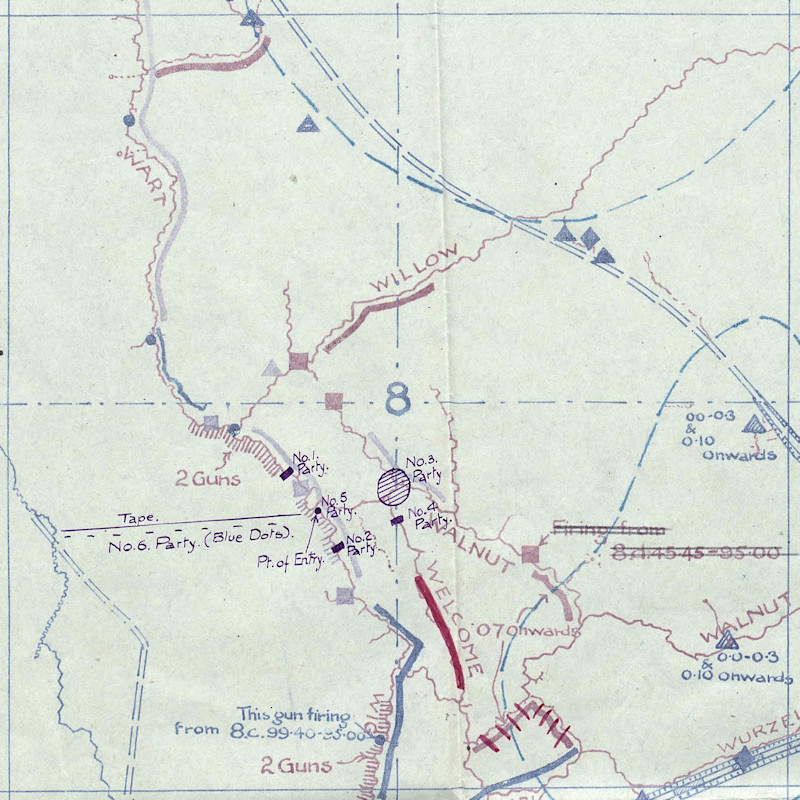
British and German trenches east of Arras from a November 1917 map. 
The square is where the raid of 30 October 1917 took place.

Detail map from the raid report showing the line taken between British and German trenches;
the British front-line trenches are those on the left.

Monday, 30 October 2017

Coolness and Courage

183rd Infantry Brigade Order No. 151, dated 23 October 1917 was for ‘A’ Company of 2/6th Battalion Gloucestershire Regiment to “raid the enemy’s trenches”. The objects of the raid were:

(a) To kill the enemy and take prisoners
(b) To destroy dugouts and emplacements
(c) To obtain identifications

The trenches in question were located close to the French village of Fampoux, east of Arras. The battalion had spent October at Hull Camp, St. Nicholas, near Arras and in support and front line trenches.

Key map for trench raid of 29/30 October 1917 

Trench detail
Specific orders for the raid were written by Captain C.H. Carruthers, the Officer Commanding ‘A’ Company. Carruthers was to lead the raid, with 2nd Lieutenant Schutze and Beale, and 60 other ranks.

The orders identified six parties with specific targets (provided by co-ordinates) within the German trenches. Some were to destroy dugouts, while others were to form stop gaps and protection. A parapet party was to cover retirement of all parties and “do anything possible to facilitate their exit.” Two Lewis guns with two men manning each gun accompanied the parapet part to deal with any enemy movement overland.

Dress for all parties was – “Rifles and 30 rounds in right-hand pocket. Two bombs per man. Additional bombs in bomb buckets. Wire-cutters and electric torches and P. bombs (No.27) will also be carried by parties concerned.”

‘D’ company were to be utilised to place a tape from point of exit in the British lines to point of entry in the enemy lines.

The raid commenced at 3 a.m. after a three minute intense bombardment.

Saturday, 28 October 2017

Cadet Class, Cairo

T.B. Minshall,
Langley Park, Norfolk
Thomas Minshall, of Northwich, Cheshire, enlisted with Cheshire Yeomanry at Chester, on 27 August 1914. The Cheshire, Denbighshire and Shropshire Yeomanry constituted the Welsh Border Mounted Brigade. In September the Brigade was posted to Norwich to join the 1st Mounted Division, the division being formed in August for the purpose of home defence.

The period September 1914 to March 1916 was spent on the Norfolk Coast. On 3 March 1916 Cheshire Yeomanry sailed from Devonport, arriving at Alexandria, Egypt, on 14 March 1916. The regiment comprised 25 officers and 451 men.

During his time in the UK, and later in Egypt, Thomas gained the following promotions:

- Appointed Lance Corporal - 17 February 1915
- Appointed Acting Corporal - 21 February 1916
- Appointed Lance Sergeant - 22 October 1916

Through 1916 the regiment took part in operations against the Senussi, and in the Baharia Expedition. At the end of the year Cheshire Yeomanry learnt it was to be formed into an infantry battalion.

As the establishment of an infantry battalion was so much greater than that of a cavalry regiment it was necessary for some amalgamations. On 1 March 1917 Shropshire Yeomanry arrived from Sherira at Helmieh Camp, Zietoun, near Cairo. The following day Cheshire Yeomanry arrived at the camp from Alamein. Here the regiments amalgamated to form 10th (Shropshire & Cheshire Yeomanry) Bn. King's Shropshire Light Infantry.

Monday, 18 September 2017

A fateful transfer...

In March 1916 the 13th (Forest of Dean) Battalion Gloucestershire Regiment were posted to northern France. A few weeks later William Britton, of Bristol, completed his basic training and was posted to the 13th. He likely joined the Battalion in France, as a member of 'D' Company, with a draft of men arriving in May. By November 1916 the 13th Battalion were in the Ypres area in Belgium, where they remained throughout 1917.

The 2/6th Battalion Gloucestershire Regiment were west of Arras in July 1917, but at the end of the month moved to northern France. From here, in mid-August, they moved to the Ypres area where time was spent in training. Mid-September they were once again on the move; heading back to northern France first, and a day of rest, then on 18 September they entrained at Cassel station bound for Arras.

It is probable that when both the 13th Battalion and 2/6th Battalion Gloucestershire Regiment were in close proximity near Ypres, August-September 1917, that William Britton transferred from D Company 13th Battalion to A Company 2/6th Battalion.

Trench map from November 1917.
British trenches (blue) / German trenches (red)
'Reproduced with the permission of the National Library of Scotland'

On arrival at Arras the 2/6th Battalion marched approximately 7 miles west to billets in Simencourt. Having rested and completed a few days training they marched to Hull Camp, at St. Nicholas, near Arras. In the latter part of September, they were working in the support trenches under the Royal Engineers; then on 30 September the Battalion forward to the front line trenches, relieving the 2/4 Battalion Gloucestershire Regiment. Following a few quiet days they in turn were relieved and returned to Hull Camp. There followed another period of rest and training, before returning to support trenches as working parties, then back to front line trenches on 22 October.

Wednesday, 19 April 2017

"Earth Shook" - 10th KSLI & the Second Battle of Gaza

Early in 1917 Turkish troops defending a line stretching from Gaza and south east to Beersheba, blocked the only viable passage for British forces advance into the heart of Palestine.

On 14 April 1917, the 10th (Shropshire & Cheshire Yeomanry) Bn. King’s Shropshire Light Infantry (10th Bn KSLI), moved from Khan Yunis to Deir el Belah the concentration area for the 74th (Yeomanry) Division. The Division comprised three Infantry Brigades, the 229th, 230th and 231st, the 10th Bn KSLI being part of the latter.

These moves were preliminary to the Second Battle of Gaza, in which the 10th Bn KSLI was to play a supporting role. The First Battle of Gaza took place on 26 March, and was unsuccessful, although Sir Archibald Murray presented it as a victory. Murray’s despatches resulted in the War Cabinet ordering a second attempt on Gaza.

The Second Battle of Gaza began on 17 April, with three infantry divisions, the 52nd, 53rd and 54th advancing and gaining a line from the Sheikh Abbas – Mansura Ridge to the coast. The 18th was then spent in consolidation and the main attack on the town launched on the 19th.

Map showing the movement of the 10th Bn KSLI
At 0030 hours on the 17th, the 10th Bn KSLI marched from Deir el Belah to a camp 3 miles to the north at Raspberry Hill, arriving at 0300 hours, and dug in. There they remained until 2030 hours on 18 April, when they marched out with the 231st Brigade, reaching a position 2000 yards south east of the Mansura Ridge at 0400 hours on the 19th, and again dug in. There they remained in reserve throughout the day.

The attack on the 19th began with a bombardment at 0530 hours after which the three infantry divisions moved forward. Serving with 10th Bn KSLI, and in reserve, Lance Sergeant Thomas Minshall in his ‘Notes on Palestine’ recorded his what he saw:
“We were aroused by the roar of guns after being on the march all night; everybody was very tired but the booming of the guns from land and sea very soon made us realise a great battle had begun. The air and earth fairly shook, shells of all calibres up to 11 inches, tore slits into the elaborate Turkish defences, the battleships pouring a deadly fire into the forts on the hills around the city.”

Monday, 3 April 2017

Into Palestine with the 10th Bn. KSLI

On 1 March 1917 Shropshire Yeomanry arrived from Sherira at Helmieh Camp, Zeitoun, near Cairo. The following day Cheshire Yeomanry arrived at the camp from Alamein. Here the regiments amalgamated to form 10th (Shropshire & Cheshire Yeomanry) Bn. King's Shropshire Light Infantry.

The first three weeks of March were spent in reorganising and equipping, followed by strenuous training in infantry work. During this time reinforcement of 69 O.R. arrived from King's Shropshire Light Infantry (KSLI) base in England. On 24 March the Battalion moved to Kantara, where a further reinforcement of 16 O.R. arrived.

Zeitoun had not been popular with the men and the move to Kantara brought a considerable improvement, including bathing in the Suez Canal. At Kantara the Battalion formed the 231st Brigade with the 24th and 25th Royal Welsh Fusiliers, and the 24th Welsh Regiment.

On 2 April 1917 at 17:50, the 10th Bn. KSLI entrained at Kantara East. As they were going into an operational zone all kit had to be strictly limited to 50lbs and the remainder left behind at Kantara. Their destination was Khan Yunis, and the Battalion War Diary simply notes that they arrived there at 15:30hrs on 3 April, encamping 1 mile east of the station. Lance Sergeant Thomas Minshall, 10th Bn. KSLI, provides some insight into the journey:
“After 22 1/2 hours packed like sardines in open trucks, we arrived at the rail head on April 3rd/17, unloaded our trucks, marched inland a short distance, and bivouaced for the night on the side of a high ridge from which we had a splendid view of the surrounding country and the Mediterranean Sea.”

Thursday, 2 March 2017

Yeomanry become Infantry

In March 1916 the Welsh Border Mounted Brigade and South Wales Mounted Brigade, comprising six yeomanry regiments, were posted to Egypt.

Welsh Border Mounted Brigade | South Wales Mounted Brigade
  • Shropshire Yeomanry
  • Cheshire Yeomanry
  • Denbighshire Yeomanry
  • Pembroke Yeomanry
  • Montgomery Yeomanry
  • Glamorganshire Yeomanry
The Brigades had been dismounted in November 1915, and their cavalry equipment handed in and changed for infantry. In Egypt the two Brigades were amalgamated to form the 4th Dismounted Brigade. Although trained as yeomanry they were to be utilised as infantry and served on Suez Canal defences, and in operations against the Senussi throughout 1916.

By November 1916 Cheshire Yeomanry knew that it was to be formed into an infantry battalion. However, because the establishment of an infantry battalion was so much greater than that of a cavalry regiment it would be necessary for some amalgamations to create  new battalions. Cheshire Yeomanry were to amalgamate with Shropshire Yeomanry to form a Battalion of the King’s Shropshire Light Infantry, and the yeomanry regiments undertook a period of infantry training in preparation for their new role.

Tuesday, 21 February 2017

The Streets And Houses Of Minia

Cheshire Yeomanry arrived at Minia, some 150 miles south of Cairo, around 2:00am on 19 April 1916 – strength was 23 officers, 440 other ranks, 6 horses and 4 mules. The Regiment had been sent to Minia to prepare for operations against the Senussi, a religious sect in Egypt, Sudan and Arabia, who were persuaded by Turkey to attack the British. By June squadrons were being detached from headquarters, which remained at Minia until September 1916, to assist in operations associated with the capture and occupation of the Baharia Oasis.

Some time, likely in April or May 1916, Corporal Thomas Minshall of “C” Squadron, Cheshire Yeomanry, gained permission to visit Minia. He later wrote the following notes for his wife Eva which describe the sights he saw. Sadly, the associated additional letters and drawings Thomas refers to have been lost during the last 100 years – however several photographs from this time survive and accompany the notes.

Wednesday, 21 December 2016

Baharia Expedition

By late August 1916, five blockhouses had been built and a sixth (B.6) was nearing completion along the Darb el Rubi track, from Samalut on the Nile towards Baharia. The light railway too was expected to reach B.6 by early October. During this period the main Senussi force, estimated at 1,800 men, was in Dakhla, the richest of the oases.

By October, Sir A. Murray was ready to reoccupy Baharia, and ordered the new Western Force commander, Major-General W. A. Watson to commence operations against it. News leaked to Sayed Ahmed, who had advanced from Dakhla to Baharia with most of his force. Ahmed retreated to Siwa from 8–10 October. An attempt was made to try and cut off the rear guard by a concentration of light cars but despite their weakened state due to hunger and illness they were able to escape.

The "warders of the desert"

It was now known that the force in Dakhla was much smaller and likely to retire soon. Watson decided to attack from Kharga. The force contained sixty men with a Rolls-Royce armoured car and a tender, six Fords and twelve motorcycles, two Vickers and two Lewis guns supported by a company of the Camel Corps. The cars reached Dakhla on 17 October, 48 hours ahead of the Camel Corps, but it was found that most of the Senussi had gone, apart from a party of about 120 men at Budkhulu in the middle of the oasis, who were taken prisoner. With the arrival of the Camel Corps on 19 October, 40 more prisoners were taken. With further patrols in the area the oasis and its 20,000 occupants had been cleared of the Senussi by the end of October. Garrisons were installed at Dakhla and Baharia and civilian government restored.

The Senussi had played the game, from their point of view, extremely well. That had kept a very considerable force from participating in the war against the Turks for many months. The result had been the expenditure of vast resources in building the block houses and the railway, all now of limited value. They had waited until the last possible moment when the block house line was completed and the railway very nearly so, before disappearing.

Sayed Ahmed was attacked and defeated at Siwa at the beginning of February 1917, by a force of aroured cars from Sollum under Brig.-General H.W. Hodgson. This finally liquidated the Wester Desert campaign by discrediting Sayed Ahmed and destroying his influence.

Thursday, 29 September 2016

Band of Oases

Commencing in February 1916 Senussi forces under Sayyid Ahmed, occupied the Baharia, Farafra, Dakkla and Kharga oases to the west of the Nile. This necessitated the 53rd Division and three brigades of dismounted Yeomanry being distributed in garrisons in Upper Egypt from Fayum to Assiut, for the whole summer.

Initially posted to Minia, some 150 miles south of Cairo, the role of the Cheshire Yeomanry was to assist in the capture and occupation of the Baharia Oasis.
“The main difficulty of the operation was the lack of any water between the Nile and the oasis. On top of this, the desert was extremely difficult to cross in places. The advance, therefore, had to be gradual in order to enable supplies to keep pace with it. To protect the lines of communications, block houses were built every ten to 12 miles. They were known as B.1, B.2, etc. Railhead for the Baharia Expedition, as it was called, was then at Samalut, close to the Nile, while the advance post was at Shusha some ten miles to the west. It was from Shusha that the block house line ran out into the desert in the direction of the oasis. At the end of April, B.4 was nearing completion. 
“As regards supplies, all food, petrol, stores and a great deal of the water required for the maintenance of the Shusha garrison and the block houses, has to be sent up from Samalut. The same was true for the materials required for the construction of the new block houses.” (The Cheshire Yeomanry, by Lt.-Col. Sir Richard Verdin, 1971)
At the same time as the block house line was gradually extended a light railway was being constructed into the desert. Progress was rapid thanks to the efforts of the Egyptian Labour Corps.

The Light Desert Railway constructed
at the rate of a mile & a half a day
Friendly natives
who are employed on the railway
(photographs by T.B. Minshall of "C" Squadron, Cheshire Yeomanry)