On the night of 29th/30th October 1917, Captain C.H. Carruthers and 2nd Lieutenants Schutze and Beale lead a party of 60 men on a raid on German trenches. All were from ‘A’ Company, 2/6th Battalion Gloucestershire Regiment. The night was fine, the moon being exceptionally bright.
The objects of the raid were straight forward:
(a) To kill the enemy and take prisoners
(b) To destroy dugouts and emplacements
(c) To obtain identifications
British and German trenches east of Arras from a November
1917 map.
The square is where the raid of 30 October 1917 took place.
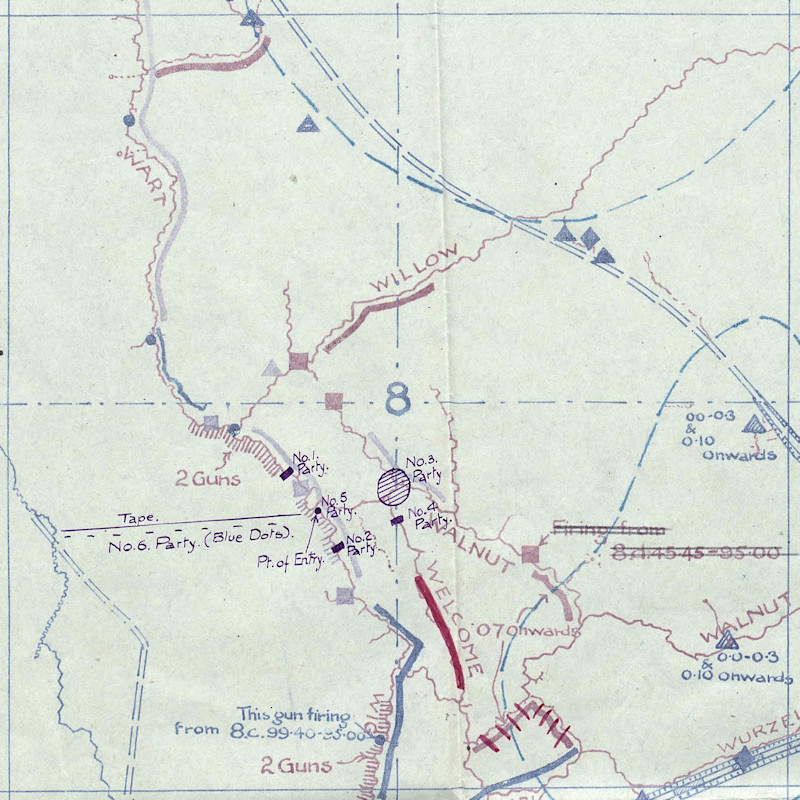
Detail map from the raid report
showing the line taken between British and German trenches; the British
front-line trenches are those on the left.
183rd Infantry Brigade Order No. 151, dated 23 October 1917 was for ‘A’ Company of 2/6th Battalion Gloucestershire Regiment to “raid the enemy’s trenches”. The objects of the raid were:
(a) To kill the enemy and take prisoners
(b) To destroy dugouts and emplacements
(c) To obtain identifications
The trenches in question were located close to the French village of Fampoux, east of Arras. The battalion had spent October at Hull Camp, St. Nicholas, near Arras and in support and front line trenches.
Key map for trench raid of 29/30 October 1917
Trench detail
Specific orders for the raid were written by Captain C.H. Carruthers, the Officer Commanding ‘A’ Company. Carruthers was to lead the raid, with 2nd Lieutenant Schutze and Beale, and 60 other ranks.
The orders identified six parties with specific targets (provided by co-ordinates) within the German trenches. Some were to destroy dugouts, while others were to form stop gaps and protection. A parapet party was to cover retirement of all parties and “do anything possible to facilitate their exit.” Two Lewis guns with two men manning each gun accompanied the parapet part to deal with any enemy movement overland.
Dress for all parties was – “Rifles and 30 rounds in right-hand pocket. Two bombs per man. Additional bombs in bomb buckets. Wire-cutters and electric torches and P. bombs (No.27) will also be carried by parties concerned.”
‘D’ company were to be utilised to place a tape from point of exit in the British lines to point of entry in the enemy lines.
The raid commenced at 3 a.m. after a three minute intense bombardment.
In March 1916 the 13th (Forest of Dean) Battalion Gloucestershire Regiment were posted to northern France. A few weeks later William Britton, of Bristol, completed his basic training and was posted to the 13th. He likely joined the Battalion in France, as a member of 'D' Company, with a draft of men arriving in May. By November 1916 the 13th Battalion were in the Ypres area in Belgium, where they remained throughout 1917.
The 2/6th Battalion Gloucestershire Regiment were west of Arras in July 1917, but at the end of the month moved to northern France. From here, in mid-August, they moved to the Ypres area where time was spent in training. Mid-September they were once again on the move; heading back to northern France first, and a day of rest, then on 18 September they entrained at Cassel station bound for Arras.
It is probable that when both the 13th Battalion and 2/6th Battalion Gloucestershire Regiment were in close proximity near Ypres, August-September 1917, that William Britton transferred from D Company 13th Battalion to A Company 2/6th Battalion.
On arrival at Arras the 2/6th Battalion marched approximately 7 miles west to billets in Simencourt. Having rested and completed a few days training they marched to Hull Camp, at St. Nicholas, near Arras. In the latter part of September, they were working in the support trenches under the Royal Engineers; then on 30 September the Battalion forward to the front line trenches, relieving the 2/4 Battalion Gloucestershire Regiment. Following a few quiet days they in turn were relieved and returned to Hull Camp. There followed another period of rest and training, before returning to support trenches as working parties, then back to front line trenches on 22 October.
On 3 March the 13th (Forest of Dean) Battalion Gloucestershire Regiment departed from Southampton, arriving at Le Havre around 6:30am the following morning. From here they moved to Thiennes in northern France, arriving on 6 March.
As Pioneers for the 39th Division they were kept busy. Moving around the region through March and April their work included making roads, constructing strong points and barbed wire entanglements, reclaiming old trenches, building dug-outs and making breast works. By 14 April they billeted in Essars and engaged in draining, making and reclaiming trenches to the rear of the front line.
On 12 April 1916 William Britton of Hotwells, Bristol, was posted to the 13th Battalion. The battalion War Diary records a draft of men arriving at Essars on 20 May and it appears highly likely that William was amongst these men where he joined D Company (an additional draft of 3 other ranks (O.R.) also arrived on the 29th).
The Battalion remained at Essars until 16 June, when they moved north east to new billets at La Couture. Here work continued on road, repair and breastwork. At the end of June there was to be a trench attack and on 25 June a party of 9 officers and 285 men moved to Pacaut to practice pioneer work in connection with this. The attack took place on the night of 29/30 June on the ‘Boar’s Head’ section of German front line near Richebourg l’Avoue (seen on the centre of the 1917 trench map below). Two parties of the Battalion comprising B and C companies were ordered to extend communication trenches, whilst A and D companies on the flanks were to construct right and left flank breastworks respectively.
Sketch map that accompanied the
"Notes on attack on German Front Line, North of the BOAR's HEAD"
13th Battalion Gloucestershire Regiment, War Diary
In the face of shelling and machine gun fire the attacking infantry were prevented from being reinforced and were running out of ammunition. The pioneers were able to complete some of their work despite these hostile conditions and attacks from German bombing parties. It is not known if William Britton was one of the D Company men, however illustrative of the difficulties encountered, following is the Company report of their part in the attack:
On looking over the parapet at 3.10 the remnants of the third infantry wave coming back under heavy shelling and Machine Gun fire. They were also being bombed from the German front line. Under these circumstances the work was out of question, and the officer in charge of the party reported to the Infantry Commander and manned portions of our front line till ordered to get his party out of the line between 7 and 8 a.m.
13th Battalion casualties as a result of this attack were 1 officer killed and 4 wounded, and 10 other ranks killed, 57 wounded and a further 13 missing.
The Battalion War Diary notes that on the evening of 1 July “2nd Lieut. Vowles with one Sergt. went out to try to recover wounded reported still alive in NO MAN’S LAND.” The was unsuccessful.
On 3 July, at 9:45am, “The raiding part paraded before General Haking, Commanding XI Corps and were complimented on their work.”
For conspicuous bravery in the action of the night of 29/30 June, one Military Cross, two Distinguished Conduct Medals and two Military Medals were awarded to men of the 13th Battalion Gloucestershire Regiment.
Late in 1914 volunteers were being sought to replace battle losses and new battalions were being formed. Labour was also becoming a significant issue on the battle front, with lines of trenches requiring construction and repair and communication links by road to the rear to be maintained. Indigenous labour was in short supply in France, given demands on their own armies. In December 1914 the War Office gave instruction that Pioneer Battalions were to be raised for each Division.
The Gloucester Journal (Saturday, 19 December 1914) reported news of recruiting meetings in the Forest of Dean for such a new Battalion. It was noted that during meetings held in December there was “close interest in the explanation that the Forest battalion would be of special usefulness in that the men being colliers would be well qualified for trench and similar work, which would be acknowledged in that the men of this battalion would have 2d. a day extra pay.”
Meetings in connection with the formation of the Forest of Dean Pioneer Battalion of the Gloucestershire Regiment continued to be held through January 1915, but recruitment was slow. Up to Monday 18 January only 90 men had been secured towards the required 1,350.
In December 1915 Lord Derby’s Group Scheme for recruitment came to a close. Under this scheme, men aged 18 to 40 were informed that they could continue to enlist voluntarily or attest with an obligation to come if called up later on. Allocation to groups was made based on age and marital status.
Newspapers on 20 December 1915 included announcement that the first call was to single men in Groups 2, 3, and 5. The men were required to commence to present themselves for service on 20 January 1916. To reduce pressure on recruiting offices and depots, the men were drafted gradually into service, some summoned on 20 January, another batch summoned for the 21st, and so forth.
William Edward Britton of Hotwells, Bristol, (born in 1895) was one of those who had attested under the Group (Derby) Scheme. Although William’s service records do not appear to have survived, medal rolls identify him as Private number 26208, Gloucestershire Regiment and that he served in both the 13th and 2/6th Battalions. Researching records of others with a service number close to William’s enables some understanding of his recruitment and initial posting.
He was mobilised on 21 January 1916 and two days later posted to the 16th (Reserve) Battalion, Gloucestershire Regiment. Such Battalions were formed to train and provide drafts for the Front. Brigadier E.A. James in his ‘British Regiments 1914-18’ provides the following brief entry regarding the 16th (Reserve) Battalion:
Formed in Nov. 1915 from depot coys. of 13th Bn. at Chisledon as a local reserve bn. in 22nd Reserve Bde. 1.9.16 became 94th Training Reserve Bn. at Chisledon to 22nd Reserve Bde.
In December 1915 the Group Scheme for recruitment came to a close. This had been introduced in order to bolster the dwindling numbers of volunteer recruits, and it is at this time that William Britton stepped forward for military service.
4 Dowry Place, Hotwells,
is the fourth property from the
right
William Edward Britton was born on 11 June 1895 at 4 Dowry Place, Hotwells, Bristol. He was the son of Thomas John Britton (1869-1939) and Georgina Eliza Vale (c1869-1947). In 1911, aged 15 William was a postmasters errand boy.
The National Registration Act of July 1915 required men aged between of 15 and 65 and not already in the military to register, giving details of their employment. Subsequent to this, Lord Derby, Director-General of Recruiting, brought forward the Group Scheme (often called the Derby Scheme) of recruitment in October 1915.
Bristol newspapers kept the topic of recruitment before their readers and the following article extract explains local arrangements:
The Bristol Recruiting Committee, in company with other recruiting authorities throughout the country, have, during the past few days, been giving serious attention to Lord Derby’s scheme – the final scheme as it is thought – for securing by voluntary means the men needed to keep our armies in the field up to strength. Briefly it means that all men of military age not starred, i.e., not engaged on munitions, aeroplane, or other Government work, are to be personally canvassed and urged to join the colours. Also, that the canvass is to be carried out by civilians under the auspices the Local Parliamentary Recruiting Committees, or where such does not exist, the political agents of the district.
As is well known the Bristol Recruiting Committee has been in existence since August, 1914, to deal with schemes of this description, and they have delegated their duties connected with the carrying out of Lord Derby’s scheme to a sub-committee consisting of the various political agents who are already members of the Committee, and also representatives of the Labour party. We understand that steps have been taken to put the canvass into operation at once.
Western Daily Press - Wednesday 20 October 1915
Under the Group Scheme, men aged 18 to 40 were informed that they could continue to enlist voluntarily or attest with an obligation to come if called up later on. A period of notice would be given to all such men before they were called up to join, so that they might wind up business affairs.
Voluntary enlistment under the scheme was to have ceased at midnight on Saturday 11 December 1915. As this date approached so there was a great rush of recruits.